French drains · American Drain

French drains, done right. And the patented system that goes further.

Most French drains are buried, untestable, and slowly fill with silt. Ours use smooth-wall PVC and a cleanout so you can watch them work. Where water volume demands more, our patented American Drain takes over.

  • Since 2002designing rainwater drainage
  • Smooth-wall PVCcommercial grade, American made
  • Easy access cleanoutsso every run can be tested
  • Transferable lifetimewarranty option on American Drain

French drain basics

Quick answer

What is a French drain?

A French drain is a trench with a perforated pipe and washed stone that collects water from the soil and carries it to a chosen discharge point, away from lawns, crawlspaces and foundations.

It works by giving water an easier path than your soil. Design decides everything: the wrong depth, slope, pipe or outlet and the drain silts up, soaks water back into the ground, or just moves the problem somewhere else.

The short version
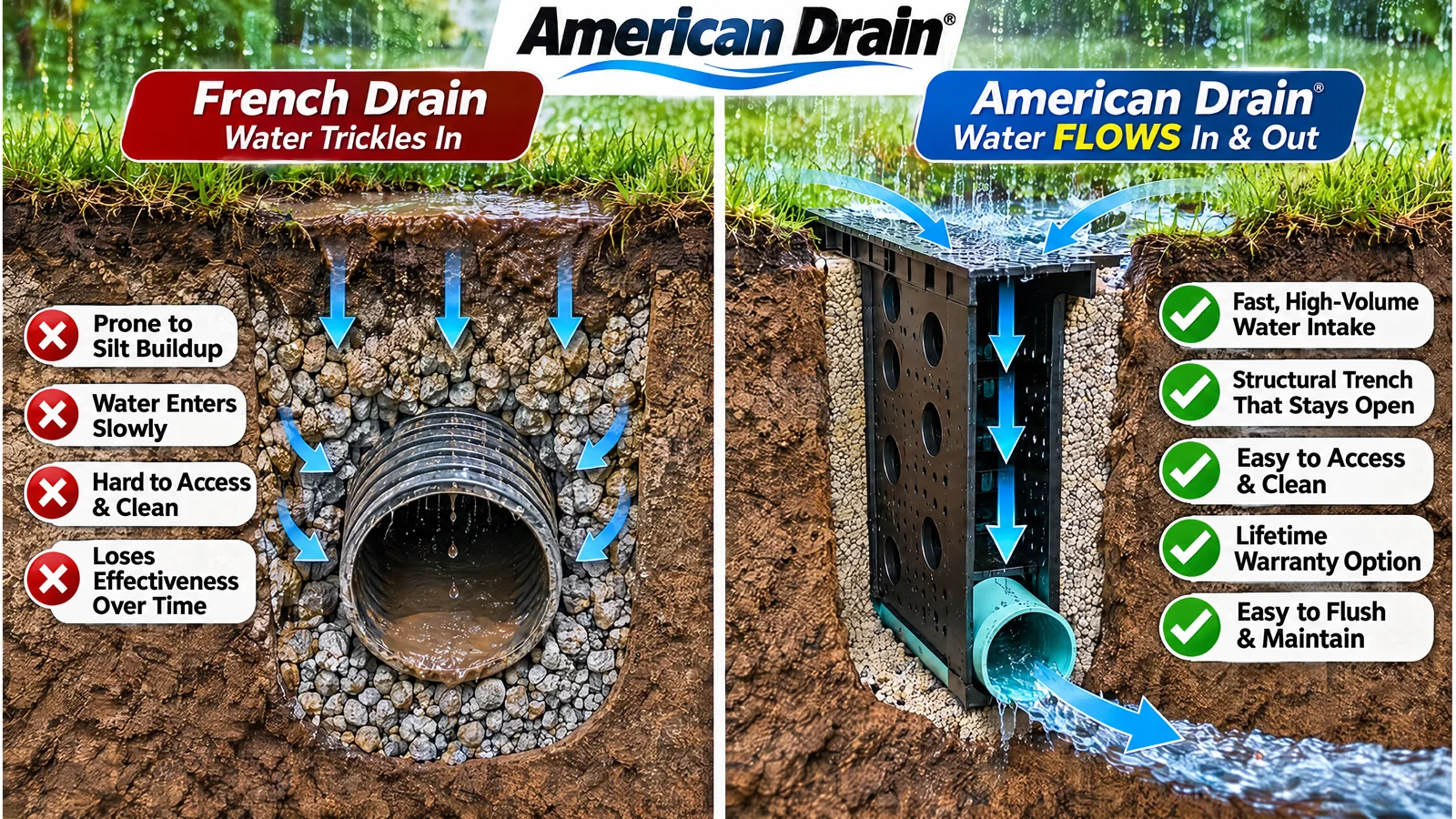
  1. Typical French drain: slotted pipe in gravel, buried with no way to test it. Often holds water and leaks it back into the soil.
  2. Drain Designs French drain: smooth-wall PVC with a cleanout at the high end. Run a hose in, and water comes out the other end.
  3. American Drain (patented): a structural trench with a removable top cap. Water enters from the top and sides, and you can lift the cap to look at the pipe.
Side by side

Three ways to drain a yard. Only two let you check the work.

How a typical installer's French drain stacks up against ours and against the patented American Drain.

Common installTypical French drain
PipeSlotted pipe that holds water in its ridges
Water entryThrough gravel and pipe slots only
Where water goesMuch of it can soak back into the soil
TestingBuried, usually no access point
MaintenanceOften means digging it back up
WarrantyVaries by installer
Drain DesignsImproved French drain
PipeCommercial-grade, smooth-wall PVC
Water entryHoles placed so water rides a trough in the lower third of the pipe
Where water goesOut the outlet to the discharge point we design
TestingCleanout at the high end: hose in, water out
MaintenanceFlush through the cleanout
WarrantyBacked by your local Drain Designs team
Patented · Drain DesignsThe American DrainHighest capacity
PipeSmooth-wall PVC under perforated structural panels
Water entryTop cap and both side panels, not just pipe holes
Where water goesStraight down to the pipe and out, built for higher volume
TestingLift the cap and look straight down at the pipe
MaintenanceRemove the cap to inspect, test or clean
WarrantyTransferable lifetime warranty option
The hose test

Run a hose in one end. What comes out the other?

This is the simplest way to judge any drain. Pick a system to see what happens to the water.

Cross-section of a drain line during a hose test Hose inOutlet

Typical French drain. Water soaks out through the slots into the surrounding soil. Hundreds of gallons can go in before much of anything reaches the outlet, which keeps the ground wet and attracts roots.

Drain Designs PVC. Water rides the trough in the lower third of smooth-wall PVC and comes out the other end right away. Our cleanout makes this test something you can repeat any time.

American Drain. Water enters from the hose, through the top cap and through the side panels, then flows out the PVC below. Lift the cap and you can watch it happen.

Drain Designs technician running a garden hose into a drain cleanout while water flows out of the outlet across the lawn
Every run we install gets a hose test before the lawn goes back down.
Inside the trench

Where the water actually gets in

Side-by-side cutaway: a traditional French drain where water trickles in through gravel, prone to silt buildup and hard to access, versus the patented American Drain, a structural trench that takes in high water volume through the top and sides and carries it out a teal PVC outlet, easy to access, flush and maintain, with a lifetime warranty option
Start here

Do you even need a French drain?

Often the answer is no. Standing water usually comes from a low spot that is getting too much water from somewhere else. Tell us where you see it.

Likely starting point

Find the source first

On many homes, downspouts dump hundreds or thousands of gallons into the lowest part of the yard. Each downspout can send roughly 200 gallons per inch of rain. Capturing that water and piping it to a better location often does more than a French drain, at a lower cost.

Every property is different. An on-site assessment confirms the right system, or combination, before you commit. Request a Quote

How we install

Six steps, and the last one is proof

  1. Technician using a laser level to survey yard gradeFind the sourceWe walk the property, trace where the water comes from, and check the grade with a laser level.
  2. Teal PVC drain line installed in a trench along a brick homeDesign the routeDepth, slope and a discharge point that sends water away from the house, never through the driveway.
  3. Compact trencher cutting a drainage trench with PVC pipe laid alongsideTrench with the right toolsCompact equipment keeps the trench clean and the disturbance to your lawn small.
  4. Drain Designs technician setting smooth-wall PVC in washed stoneSet smooth-wall PVCCommercial-grade pipe in washed stone and fabric, with a cleanout at the high end of every drain.
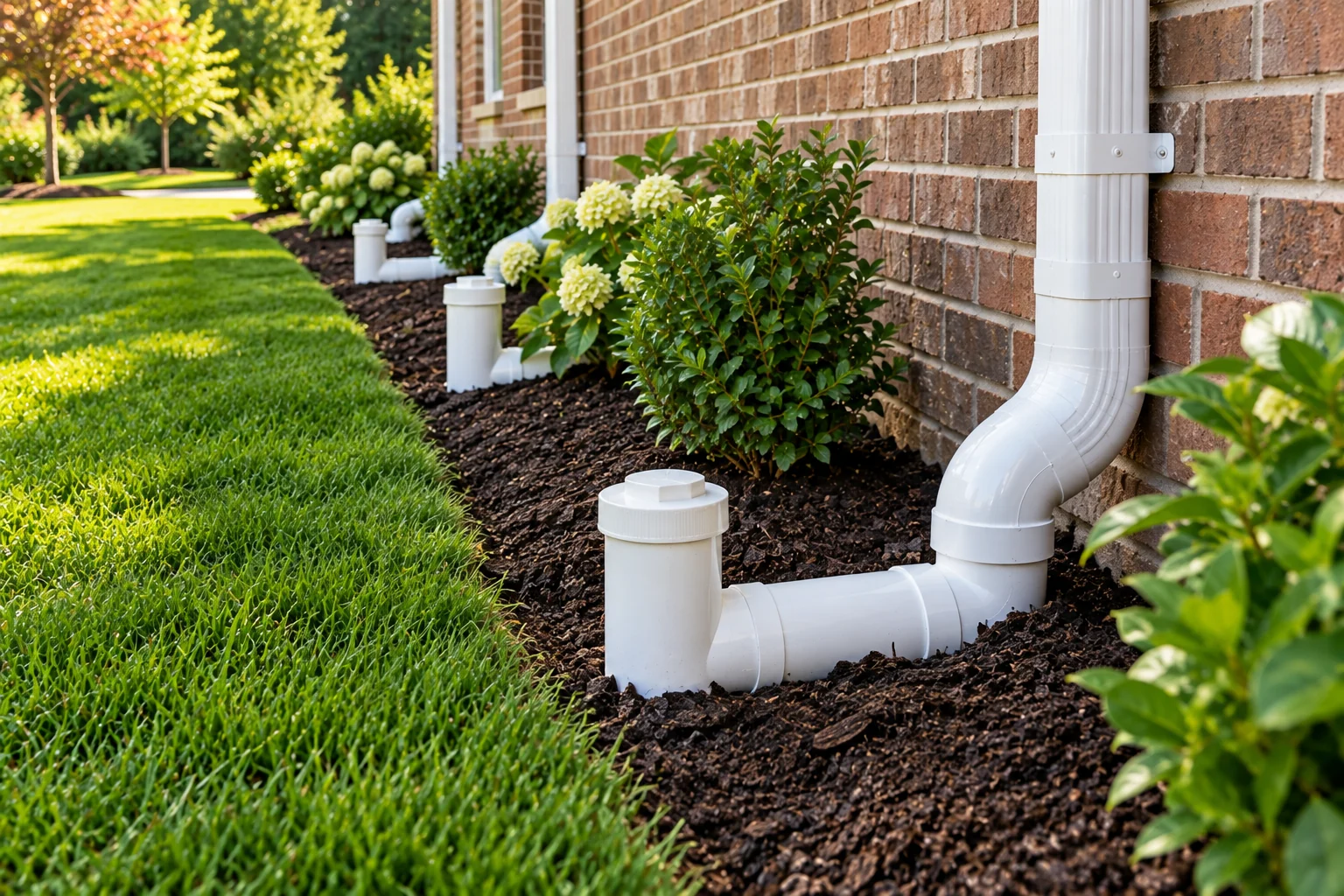
  5. Easy-access white PVC cleanouts along a foundation bedHose-test every runWater goes in the cleanout and has to come out the outlet before we close anything up.
  6. Finished American Drain along a curved walkway edgeRestore and documentWe put the yard back and can give you photos and a drawing of the system for your records.
Real Drain Designs jobs

Not stock photos. Our crews, our pipe.

Teal PVC downspout manifold with white fittings beside a brick walkway
Downspout manifold into smooth-wall PVC
PVC drain run installed along a brick patio and fence
Drain run along a brick patio
American Drain panels with teal PVC installed along a concrete walkway bed edge
American Drain at a walkway bed edge
American Drain structural panels staged on site with PVC pipe
American Drain panels on site
Real job footage

Watch the water leave

Real clips from Drain Designs jobs. Muted, and they only play while on screen.

Outlet discharging into the woods
Outlets flowing after rain
Curb outlet discharging
Cost

What does a French drain cost?

Around $100 per foot

A common average for a French drain. Your number depends on four things, and the gap between an easy run and a hard one can be large. After an on-site assessment you get a written, itemized quote.

Request a Quote
  • DepthA 2-foot-deep drain can cost about three times as much as a 12-inch drain.
  • AccessA drain near the driveway may cost half as much as one 200 yards from where the truck can park.
  • Soil haul-offDeeper trenches mean more dirt to remove from the site.
  • LengthLonger runs add pipe, stone and labor.

Bar length shows relative impact on price. Our systems are designed to cost far less than the repairs and depreciation that poor drainage can lead to.

Why Drain Designs

Built by drainage specialists, not landscapers

French drains are often installed by landscapers and general contractors who don't work with subsurface water every day. Some parts of drainage are not intuitive, and that is where most failed drains come from.

  • Commercial-grade, smooth-walled, American-made PVC throughout every system
  • Easy-access cleanouts on every drain for testing and flushing
  • We never install corrugated pipe, and we recommend replacing it with PVC
  • Research and development with engineers, landscapers and builders for local soils and climate
  • Photos and a drawing of your system available for your records and for resale
  • Transferable lifetime warranty option on the American Drain
Kevin Kondas, owner of Drain Designs

“When you run a hose into a typical French drain, hundreds of gallons may soak into the ground before any comes out the other end. When you run a hose into ours, water comes out the other end.”

Kevin KondasOwner, Drain Designs · inventor of the American Drain
FAQ

French drain questions, answered

More in our French drain FAQ and the American Drain vs. French drain comparison.

What is a French drain?

A French drain is a trench with a perforated pipe and washed stone that collects water from the soil and carries it to a chosen discharge point, away from lawns, crawlspaces and foundations. Despite the name, it is named after Henry French, an American, not the country.

What is a foundation drain?

A foundation drain is a French drain placed along the base of a crawlspace, basement or retaining wall before it is waterproofed and backfilled. It lets water that would build up against the wall bleed out to a lower point in the yard, or into a sump pump that sends it away from the house.

How long does a French drain last?

It depends on the pipe and the design. Systems built with slotted corrugated pipe can stop working well soon after installation, because the pipe holds water in its ridges and lets it seep back into the soil. A properly designed smooth-wall PVC system with a cleanout is built for a long service life with proper maintenance.

Is a French drain the best solution for a wet, muddy yard?

Most of the time, no. French drains work well on flat areas and along foundations, but standing water in a yard usually comes from a low spot that receives too much water from somewhere else, most often the downspouts. Finding and managing that source usually gives you more for your money.

How do I clean or maintain my French drain?

Every drainage system needs some maintenance. A well-built French drain has an easy-access cleanout at its high end. Run water into it and you should see it come out the outlet. If you have a corrugated system that swallows water without much coming out, we recommend replacing it with PVC.

How much does a French drain cost?

French drains can average around $100 per foot. Depth, access, soil haul-off and length drive the final number. A 2-foot-deep drain can cost about three times as much as a 12-inch drain, and a drain far from truck access costs more to install.

How deep should a French drain be in clay soil?

In clay, a French drain often needs to be more than 2 feet deep to be effective. Shallow drains only dry the soil within a couple of feet of the trench.

Do I need a French drain or an American Drain?

It depends on your soil, water volume and discharge options. Many designs pair American Drains in critical zones with underground downspout piping and grading improvements. An on-site assessment confirms which system, or combination, fits your property.

How do I choose a French drain contractor?

Look for a company that specializes in drainage, has strong reviews, and installs smooth-wall PVC with cleanouts you can test. Ask how they will choose the depth and the discharge point, and ask to see the system tested before the trench is closed.

Drainage assessment

Get your drainage assessment

Standing water, soggy turf or a damp crawlspace? A local Drain Designs specialist will find where the water comes from, test any existing drains, and give you a written, itemized quote for the system your property needs.

Each Drain Designs location is independently owned, so your request goes straight to the local team.

Or choose your location from the list

Enter your ZIP code above to open your local team’s request form, or call 1-800-DRAINAGE (800-372-4624) and we will route you.

Find out which system your property needs.

On-site drainage assessment and a written, itemized quote.